
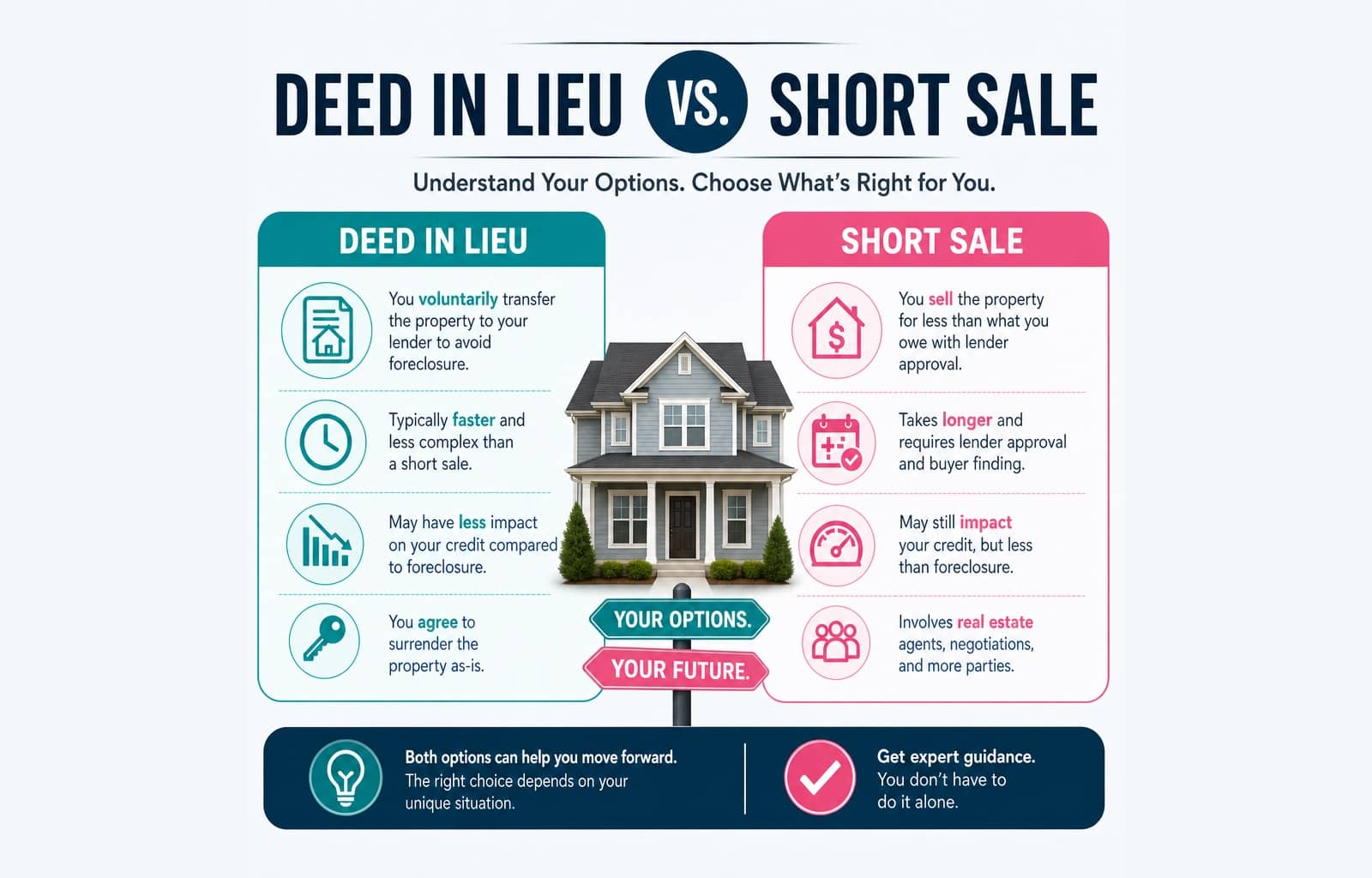
Deed in Lieu vs. Short Sale: What Homeowners Need to Know
By The Storck Team – Supporting Colorado Families Through Their Hardest Housing Moments
There’s a moment many Colorado homeowners never expect to face. It usually happens late at night, when the house is finally quiet, and the weight of the mortgage notice sits heavy on the kitchen counter. You stare at the numbers, the past‑due balance, the letters from the lender, and you feel that sinking fear in your stomach; the one that whispers, “I’m running out of time.”
If you’re reading this, you might be in that moment right now. And if you are, take a breath. You’re not alone. More importantly, you have options!
Colorado’s housing market in 2026 is still strong on the surface, but behind the scenes, more families are struggling than most people realize. According to ATTOM’s 2026 foreclosure activity report, Colorado saw a 26% increase in foreclosure filings year‑over‑year in Q1 statewide. Rising interest rates, stagnant wages, medical debt, and job changes have pushed many good, hardworking people into impossible situations.
But foreclosure is not the only path. And it’s not the one you deserve.
Two alternatives (a deed in lieu of foreclosure and a short sale) can help Colorado homeowners protect their dignity, their credit, and their future. But they work very differently, and choosing the wrong one can have long‑term consequences.
This guide breaks down both options in a clear, compassionate way, so you can understand what’s right for your situation. And if you need someone to walk with you through the process, The Storck Team is here, especially Tatyana, our CDPE Certified Distressed Property Expert, who has helped Colorado families navigate these decisions for more than a decade.
Let’s start with the basics.
What Is a Deed in Lieu of Foreclosure?
A quiet exit, but only if the lender agrees.
A deed in lieu of foreclosure is the simplest way to avoid foreclosure on paper. You voluntarily transfer ownership of your home back to the lender, and in exchange, the lender agrees to stop the foreclosure process.
It’s private. It’s fast. And it can feel like a relief when you’re overwhelmed.
But in Colorado, there’s a catch, a big one.
Colorado is a recourse state, which means lenders can legally pursue you for the remaining balance after the home is transferred unless they explicitly waive the deficiency in writing. Without that written waiver, you could still owe tens of thousands of dollars even after giving up the home.
A deed in lieu only works smoothly when:
- You have no junior liens (no second mortgage, HELOC, tax lien, or HOA lien)
- The home is in good condition
- The lender believes taking the home back is financially better than selling it
- You’ve already attempted to sell the home
If any of these pieces don’t line up, the lender will likely reject the deed in lieu and push you toward a short sale anyway.
For some homeowners, a deed in lieu is the right choice, especially if privacy and speed matter most. But for many, it’s not the safest option.
What Is a Short Sale?
A negotiated sale that protects your future.
A short sale happens when you sell your home for less than what you owe, and the lender agrees to accept the reduced amount as full payoff. It’s more work than a deed in lieu. It takes longer. And yes, it involves listing the home. But here’s the truth most homeowners don’t hear: Short sales offer more protection, more forgiveness, and more control than any other foreclosure alternative.
In Colorado, short sales are often the preferred option for both lenders and homeowners because:
- Lenders recover more money than they would through foreclosure
- Homeowners can negotiate deficiency waivers
- Homeowners can often qualify for a new mortgage in as little as two years
- The credit impact is softer and easier to rebuild
- The process is structured, predictable, and handled by professionals
In 2026, short sales have become more common again in Colorado’s distressed markets (especially in Denver, Aurora, Thornton, and Colorado Springs) as homeowners struggle with rising payments and limited refinancing options.
How the Two Options Compare (Colorado‑Specific)
Let’s break it down in a way that’s easy to understand.
Credit Impact
- Deed in Lieu: Typically a 50-125 point drop
- Short Sale: Typically a 75-150 point drop
- Foreclosure: Often a 200-300 point drop
Short sales and deeds in lieu both protect your credit far better than foreclosure, but short sales often look more favorable to future lenders.
Future Mortgage Eligibility
- Short Sale: Eligible again in 2 years
- Deed in Lieu: Eligible again in 4 years
- Foreclosure: Eligible again in 7 years
If you want to buy again sooner, a short sale is the clear winner.
Deficiency Balance
- Deed in Lieu: Only waived if the lender agrees in writing
- Short Sale: Often negotiated and approved as part of the process
Short sales give you more leverage and more protection.
Timeline
- Deed in Lieu: Fastest option
- Short Sale: Typically 3-6 months
- Foreclosure: Colorado’s non‑judicial process moves fast – often 110-125 days
Short sales take longer, but that time gives you breathing room, control, and negotiation power.
Privacy
- Deed in Lieu: Most private
- Short Sale: Listed publicly, but handled professionally
- Foreclosure: Public record, auctioned, and visible to anyone
If privacy is your top priority, a deed in lieu may feel more comfortable, but it comes with risks.
Which Option Is Better for Colorado Homeowners in 2026?
Every situation is different, but here’s the honest truth:
A deed in lieu can work beautifully, but only when the stars align. A short sale works even when things are messy.
Short sales allow you to:
- Negotiate debt forgiveness
- Avoid deficiency judgments
- Control your move‑out timeline
- Protect your credit
- Rebuild faster
- Walk away with dignity
And when you have a CDPE‑certified expert guiding you, the process becomes far less overwhelming.
Why Working With a CDPE Expert Matters (Especially in Colorado)
Short sales and deeds in lieu are not simple transactions. They involve:
- Negotiating with lenders
- Understanding investor guidelines
- Navigating Colorado’s foreclosure laws
- Managing timelines
- Handling hardship documentation
- Protecting you from deficiency judgments
- Coordinating with title companies
- Communicating with mortgage insurers
- Keeping the process moving when lenders stall
This is not something any agent can do. This is not something any homeowner should do alone.
Tatyana, The Storck Team’s Certified Distressed Property Expert (CDPE), has spent years helping Colorado families avoid foreclosure with compassion, strategy, and deep expertise. She understands the emotional weight of these decisions and the legal and financial consequences behind them.
When you work with a CDPE, you’re not just getting a real estate agent. You’re getting an advocate. A negotiator. A protector. Someone who knows how to talk to lenders in their language and how to fight for your best outcome.
If You’re Behind on Payments in Colorado, Here’s What You Should Do Next
Talk to a CDPE expert before your lender makes the decision for you.
The earlier you reach out, the more options you have. The more time we have to negotiate. The more power you have in the outcome.
Whether you’re:
- 30 days behind
- 90 days behind
- Already in the foreclosure process
- Facing a Notice of Election and Demand
- Or simply scared of what’s coming
We can help you understand your options and protect your future.
Reach out to The Storck Team today and schedule a confidential, judgment‑free consultation with Tatyana, our CDPE Certified Distressed Property Expert.
She will:
- Review your loan
- Explain your options
- Contact your lender
- Protect you from unnecessary damage
- Guide you through a short sale or deed in lieu
- Help you avoid foreclosure
- And support you emotionally through every step
Call, text, or message us today. Your home, your credit, and your future are worth the conversation.